Atlassian just cut 1,600 jobs because AI can do the work instead. Block did the same thing weeks earlier. In the first ten weeks of 2026, Australian tech companies eliminated 4,450 roles. That is more than five times the total for all of 2025.
These are not warehouse workers or retail staff. These are software engineers, product managers, analysts, and designers. The people earning $150,000 to $300,000 a year. The people servicing million dollar mortgages in every major city in the country.
Anyone working with AI tools every day can see it. What is happening in tech right now does not match the conversation happening around Australian housing.
Australian house prices only go up
That is the default position. If you have lived in this country for any amount of time, you have absorbed it. Prices dip, people panic for a month, and then they go back up. Anyone who calls the top gets laughed at.
In 2004, the OECD estimated Australian housing was 51.8% overvalued. The Economist called Australia “America’s ugly sister.” In 2008, people assumed the GFC would finally do it. Steve Keen famously predicted a 40% crash and ended up walking to Mount Kosciuszko when he lost the bet. The IMF flagged Australia’s price to income ratio as dangerously high in 2014. The OECD warned of a “dramatic and destabilising” hard landing in 2016.
None of it happened.
And for good reason. Every time Australian housing looked wobbly, something saved it. The RBA cut rates. Immigration surged. The government rolled out first home buyer grants. Negative gearing and the CGT discount kept investor money flowing. Supply never caught up with demand. These were not lucky breaks. They were real structural supports that kept the market propped up for decades.
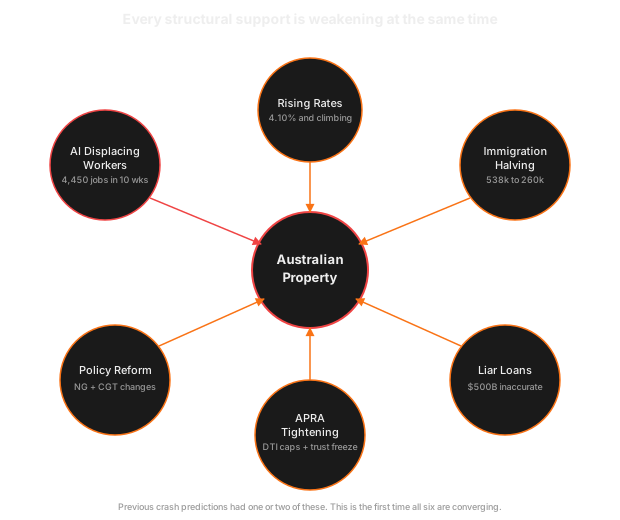
The question is simple. What happens when all of those supports weaken at the same time?
The numbers right now
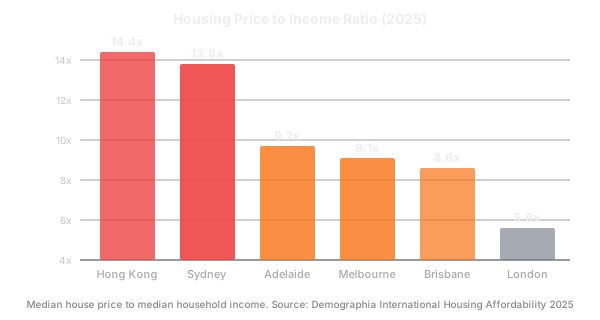
The national median dwelling value is $922,838. The mean is $1,074,700. Sydney’s median house price is around $1.75 million, which puts it at 13.8 times the median household income.
That makes Sydney the second least affordable city on the planet. Behind only Hong Kong. Five Australian cities rank in the global top 15 for unaffordability.
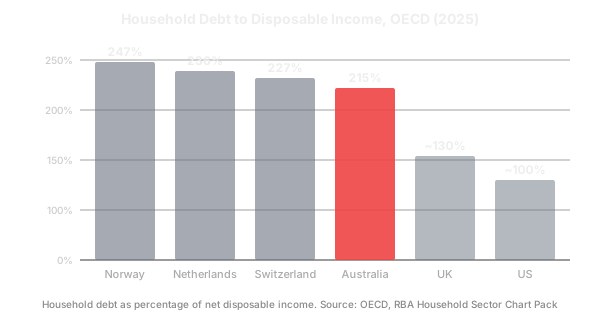
Australian household debt stands at 176.1% of disposable income. Total household debt hit a record $3.33 trillion in mid 2025.
Fourth highest in the OECD. Only Norway, the Netherlands, and Switzerland are higher.
Roy Morgan data shows 1.319 million mortgage holders, or 26.6% of all mortgage holders, classified as “at risk” of mortgage stress. Another 830,000, about 17.1%, are classified as “extremely at risk.” These numbers jumped sharply after the RBA’s February and March rate hikes, reversing a brief period of relief.
The Australian property market is not entering this period from a position of strength. It is stretched to its historical limits on every metric that matters.
Rates are going the wrong way
The RBA cash rate is at 4.10% after back to back hikes in February and March 2026. The February hike was unanimous. The March hike was split, five votes to four, with the RBA governor warning of recession risk if inflation is not brought under control.
This matters because markets had priced in rate cuts. Borrowers expected relief. They got the opposite.
Major banks are now forecasting another hike to 4.35% in May 2026. AMP suggests the cash rate may rise up to two more times during 2026 if inflation persists. NAB has already passed through the March hike, raising variable home loan rates effective immediately.
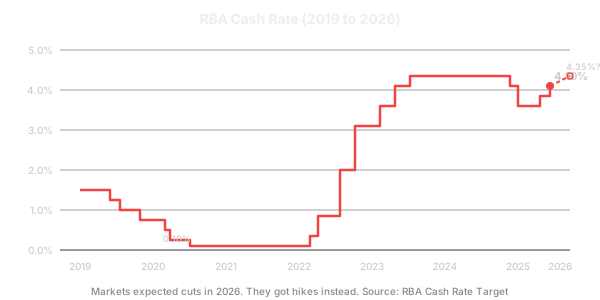
Every previous property scare was met with emergency rate cuts. That was the safety valve. When things got wobbly, the RBA stepped in and made money cheaper. That valve is now closed. It is actively working in reverse. The 830,000 “extremely at risk” mortgage holders took on their debt expecting rates to come down, not go up.
Immigration is slowing
Net overseas migration peaked at 538,000 in 2022/23. It fell to 429,000 in 2023/24 and then to 306,000 in 2024/25. The government forecasts it will drop to 260,000 for 2025/26 and continue falling to 225,000 by 2027/28.
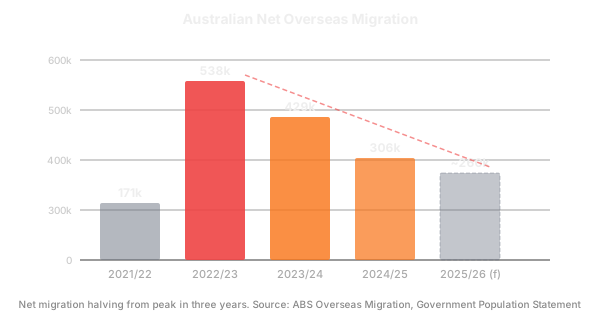
That is a halving from peak in the space of a few years.
Both major parties are now competing on who can cut it faster. The Coalition wants the permanent programme down from 185,000 to 140,000. Labor tightened visa rules and raised the skilled migration income threshold to $76,515. International student arrivals are falling. Working holiday departures more than doubled two years in a row.
Immigration was the single biggest demand driver for Australian housing. More people meant more buyers and more renters. When that flow halves, demand drops hard.
Neither party wants to be seen reopening the tap.
The policy safety net is fraying
For decades, negative gearing and the 50% CGT discount have been sacred cows of Australian property investment. They made it rational to buy investment properties at a loss because you could offset the losses against your income and pay half the tax on capital gains when you eventually sold. Property stopped being an investment class and became the national religion.
That is changing.
The Albanese Government has confirmed it is examining changes to both negative gearing and the CGT discount ahead of the May 2026 budget. Reported options include limiting negative gearing to a maximum of two investment properties per person and reducing the CGT discount from 50% to 33%. Senator David Pocock has called for removing the CGT discount entirely for residential property purchased after July 2026.
On the regulatory side, APRA introduced a debt to income cap in February 2026, limiting lenders to issuing no more than 20% of new loans at six times income or higher. That sits on top of the existing 3% serviceability buffer, which means borrowers are now stress tested against rates above 7%. Macquarie Bank paused all new home loans to trust and company borrowers entirely. CBA now requires trust borrowers to hold an existing lending relationship for at least six months before they can apply through a broker. The structures that sophisticated investors used to scale their portfolios are being shut down one by one.
Even the uncertainty is damaging. If you are an investor weighing up whether to buy another rental property, and the government might halve the tax benefit next month while regulators are capping how much you can borrow, you wait. And if enough investors wait, or start selling to lock in gains before the rules change, a wave of listings hits the market at the worst possible time.
The loans themselves are shaky
There is another layer to this that does not get enough attention. A significant portion of the mortgage book is built on applications that were not accurate in the first place.
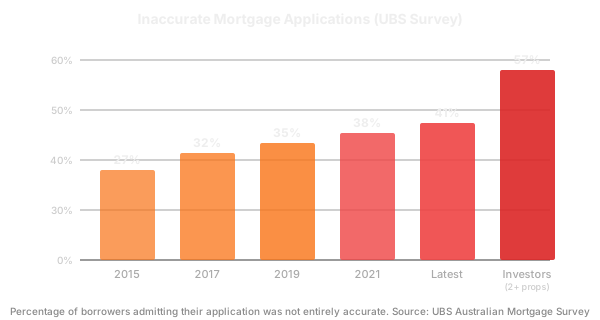
UBS ran annual surveys of recent mortgage holders for seven years. In their most recent data, 41% of borrowers admitted their mortgage application was not entirely factually accurate. That is a record high, up from 27% when the survey began in 2015. Among property investors with two or more investment properties, the figure was 57%.
Borrowers who used mortgage brokers were far more likely to submit inaccurate applications (44%) compared to those who went directly to a bank (29%). In most of those cases, borrowers said the broker advised them to misrepresent their finances. UBS estimated this equated to roughly $500 billion in factually incorrect mortgages sitting on Australian bank books.
It is getting worse, not better. Lenders stopped $1.5 billion in fraudulent applications in 2025. First party fraud jumped 25.5% year on year. A former CBA and NAB banker was charged with 89 fraud offences over a $105 million fake loan syndicate. ASIC banned a Sydney broker for ten years and sued Westpac’s RAMS unit over fabricated payslips. And in a recent survey, 52% of Gen Z respondents said they believed it was acceptable to deliberately misrepresent income on a mortgage application.
These shaky loans work fine when rates are low and the borrower stays employed. When either of those conditions changes, the cracks appear fast. When both change at the same time, the problem compounds.
AI is the catalyst
Every failed prediction about Australian housing had the same weakness. There was no catalyst.
Overvaluation alone does not cause crashes. You need something that forces people to sell. Falling prices on their own are not enough because Australians have full recourse mortgages and a cultural attachment to holding on. You need a trigger that makes people unable to pay.
AI is that trigger.
Atlassian cut 1,600 jobs globally in March 2026. 480 of them in Australia. Explicitly because AI can replace the work. Block cut 4,000 roles, roughly 40% of its entire workforce, and reorganised the company around an “AI first” operating model. WiseTech Global announced 2,000 job cuts, almost 30% of its workforce, because “the era of manually writing code is over.” Other Australian firms have followed. Sydney is the third most affected city globally for tech layoffs in 2026, behind only Seattle and San Francisco.
This is not theoretical. This is happening right now.
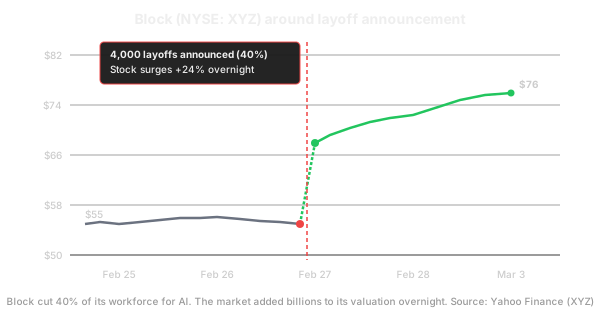
When Block announced those 4,000 layoffs, the stock surged 24% in a single day. The market did not punish the company for gutting its workforce. It rewarded it. Analysts praised the “improved profitability potential.” Management raised its 2026 margin outlook. Investors piled in.
The message to every other CEO was clear. Cut your people, replace them with AI, and your stock goes up.
That is not a one off incentive. That is a feedback loop.
And it is not going to stop. A Duke University CFO survey from March 2026 found that CFOs privately admit AI related layoffs will be nine times higher in 2026 than in 2025. Microsoft’s AI chief, Mustafa Suleyman, said in February 2026 that all white collar work could be automatable within 18 months. Anthropic published research flagging the potential for a “Great Recession for white collar workers,” finding that the most exposed roles include programmers, customer service staff, and data entry workers.
Australia is uniquely exposed. Our economy is disproportionately services based. We do not make things. We sell professional services, financial services, and houses to each other.
AI threatens the first two directly. The third depends entirely on the incomes generated by those industries.
The people losing their jobs are not minimum wage workers who rent. They are the $150,000 to $300,000 earners who bought houses and apartments in every major city in Australia. They hold the most expensive mortgages in the country. When they lose their roles, they cannot simply get another job at the same salary because the roles themselves are disappearing.
The same task that employed three people now employs one person and a subscription to an AI tool.
AI displaces white collar workers. Those workers cannot service their mortgages. Forced sales increase supply. Prices drop. Other homeowners slip into negative equity. More selling. More price drops. And unlike a normal downturn, the jobs are not coming back when the economy recovers. The roles no longer exist.
White collar workers are the new factory workers. The difference is that factory workers were not holding million dollar mortgages in every capital city in the country.
This is bigger than property
If Australian housing falls, it does not stay contained to housing.
The whole economy is wired into it.
Australians treat their homes as ATMs. Mortgage redraw facilities, equity releases, and refinancing have turned rising property values into a source of consumer spending for decades. When your house goes up $200,000, you feel richer. You renovate the kitchen. You take the holiday. You buy the car. That is the wealth effect, and in Australia it runs on property more than almost any other country.
Now run it in reverse. Property drops 15%. You are not renovating. You are not spending. The restaurants and retailers that depend on that spending start laying off staff. Those staff cannot pay their mortgages either.
The wealth effect becomes a poverty effect. And it feeds back into property prices.
Then there is the bank of mum and dad. If it were an actual lender, it would rank between the 5th and 9th largest mortgage lender in the country. The Productivity Commission estimates parents collectively lent between $22 billion and $71 billion in 2024. 40% of first home buyers relied on parental help to get in. The average deposit gift is $74,000.
That money comes from the parents’ property equity.
If property values drop, the bank of mum and dad goes bust. Fewer first home buyers get in. Fewer bottom of the ladder transactions happen. The whole chain seizes up.
Nobody in power is incentivised to let this happen. Nearly half of federal politicians own investment property, more than triple the national average. Their voters own property. Their donors own property. Every policy lever has been pulled for decades to keep prices going up. Negative gearing. First home buyer grants. Immigration settings. The entire political class has a vested interest in the housing market not falling.
Which is exactly why when it does fall, the response will be slow, conflicted, and inadequate.
Rental yields are already being squeezed. Net yields sit around 2.7% to 3.2% nationally. If AI displaces workers who default on mortgages and become renters, you might think that helps rental demand. But immigration is halving at the same time.
Investors get hit from both directions. Property values dropping and rental income softening. The negative gearing math that made investment property work for thirty years breaks completely.
How fast can sentiment flip? Ask Dubai.
If you think property markets only move slowly, look at what just happened in Dubai. When the Iran conflict broke out on February 28, Dubai’s real estate index dropped 20 to 30% in two weeks. Transaction volumes fell 25%. An estimated $250 billion in property value evaporated in days. Prices themselves only softened 4 to 5%, but the psychological shift was instant. Buyers froze. Listings spiked. The narrative went from “Dubai property only goes up” to “get me out” overnight.
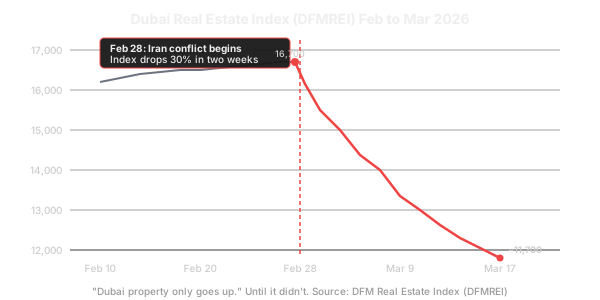
Dubai is not Australia. But the lesson is the same. Property markets are confidence games. They move on sentiment as much as fundamentals. And when the narrative shifts, it shifts fast. The people who say Australian housing cannot fall 20% are the same people who said Dubai was immune to geopolitics three months ago.
What could prove me wrong
The strongest bull case is supply. Australia does not have enough houses. The National Housing Accord is over 56,000 homes behind target after its first year. Dwelling approvals dropped 30% in late 2025. There is a 130,000 construction worker shortfall. This is real. It is the reason prices have been resilient for so long.
But Australia also has no shortage of land. This is one of the least densely populated countries on earth. The constraint is planning and construction, not physical space. And undersupply only supports prices if there are enough buyers who can pay. Remove the buyers and the shortage stops mattering.
The RBA could cut rates aggressively. That would help. It would also mean the economy is in recession, which is its own disaster for property. Rate cuts to save the housing market only work when people still have jobs. If the rate cuts are happening because AI displaced the workforce, the medicine does not treat the disease.
Maybe AI displacement happens slower than the current trajectory suggests. Maybe the layoffs plateau. That is the most honest counter. But the pace in the first quarter of 2026 does not suggest a plateau. Companies are not waiting for AI to be perfect. They are cutting now and figuring it out later. And the stock market is rewarding them for it. That incentive structure does not slow down.
Immigration could rebound. The government could introduce new stimulus. Both are possible in theory and toxic in practice. Both parties just spent an election competing on who would cut immigration more. Housing affordability is the top voter concern. No politician is going to pump demand while simultaneously promising to make housing cheaper.
Every escape hatch requires a sharp reversal in a trend that is currently accelerating.
For the record, at the time of writing (March 2026), the Cotality national Home Value Index sits at a median of $922,838, with annual growth of 9.9%. Sydney’s median is $1.75 million. Melbourne is flat. Brisbane, Adelaide, and Perth are still rising. This is the high water mark I am writing against. Come back in a few years and see where these numbers are.
I think Australian capital city property prices are going to fall. Not a dip that recovers in a quarter. A sustained correction.
If that sounds like another false alarm, look at Canada. Structurally similar economy. Similar bubble. Similar household debt levels. They tightened immigration in 2024 and experienced their first ever population contraction. Toronto home prices are already down 8% year on year. Ontario fell 6.4% in 2025. And Canada does not even have the AI displacement problem hitting its white collar workforce at the same pace Australia does.
If Canada can correct with fewer headwinds, Australia can correct with more.
Twenty years of wrong predictions should make anyone cautious. But none of those predictions had AI in the mix. And none of them had everything else going wrong at the same time.
Rates rising. Immigration falling. Policy incentives being pulled back. The mortgage book riddled with inaccurate applications. And the highest earning cohort of borrowers facing the automation of their jobs.
Sources
Housing Data
- ABS: Total Value of Dwellings, December 2025
- Demographia International Housing Affordability 2025
- Cotality: Australia’s Housing Affordability Hits New Lows
- Morningstar: Australian House Prices Close in on World Record
- Firstlinks: Australian Housing Twice as Expensive as the US
Household Debt and Mortgage Stress
- RBA: Household Sector Chart Pack
- CEIC: Australia Household Debt to Disposable Income
- Compare the Market: Household Debt Income Ratio
- Roy Morgan: Mortgage Stress Risk December 2025
Interest Rates
- RBA: March 2026 Monetary Policy Decision
- RBA: Cash Rate Target
- Canstar: Interest Rate Forecast 2026
- CommBank: RBA March Decision
Immigration
- ABS: Overseas Migration 2024/25
- Grattan Institute: Cutting Migration and Housing
- SBS: Inside Australia’s 2026 Migration Shift
Policy Reform
- PBO: Phase Out Negative Gearing Costing
- The Conversation: Cutting CGT Discount Impact
- Accounting Times: Senator Pocock Backs CGT Reforms
- APRA: Limit High Debt to Income Home Loans
- Aus Property Professionals: Major Lenders Shutting the Door on Trust Lending
- FINSTREET: Australian Mortgage Lending Outlook 2026
Liar Loans and Mortgage Fraud
- UBS: Liar Loans Hit Record Level
- ANZ Records Highest Level of Liar Loans: UBS Survey
- Broker News: AI Fuelled First Party Fraud Surges, Lenders Fight $1.5bn
- The Nightly: Big Banks, AUSTRAC Race to Uncover $1 Billion AI Driven Mortgage Fraud
- ASIC: Sydney Mortgage Broker Banned for Ten Years
- The Adviser: Liar Loans Back in Spotlight
AI and White Collar Displacement
- Fortune: Anthropic Research Flags “Great Recession for White Collar Workers”
- Anthropic: Labour Market Impacts of AI
- Fortune: CFOs Admit AI Layoffs Will Be 9x Higher in 2026
- TechCrunch: Atlassian Cuts Staff for AI
- Dynamic Business: Australia Tech Layoffs Exceed All of 2025
- Fortune: Microsoft AI Chief Says 18 Months
- The Nightly: AI Job Shock Hitting Tech Workers
Dubai Property Market
- World Property Journal: Iran War Impact on Dubai Real Estate
- CNBC: Dubai Scrambles to Save Reputation as Haven for Rich
- Business Standard: Dubai Real Estate Index Tanks 20%
- Trade Brains: Dubai Real Estate Lost $250 Billion in Days
Wealth Effect and Bank of Mum and Dad
- Unloan: How the Bank of Mum and Dad Is Shaping Australia’s Housing Market
- Mozo: Bank of Mum and Dad Report 2025
- Australian Property Update: How the Bank of Mum and Dad Is Powering Homeownership
- Deloitte: Australian Reverse Mortgage Survey 2026
Rental Yields
Housing Supply
- HIA: Home Building Outlook 2026
- IPA: National Housing Accord 56,000 Homes Behind
- ABS: Building Approvals January 2026
Block Layoffs and Market Reaction
- Fortune: Block CEO Jack Dorsey Lays Off Nearly Half Staff for AI
- InvestorPlace: Block’s Layoffs Reveal the Dark Side of the AI Economy
- KRON4: Block Stock Surges Post Layoffs, Raising AI Alarm Bells
Politicians and Property
- Open Politics: Politicians and Their Real Estate Investments
- SBS: Politicians and Their Property Portfolios
WiseTech Global
- ACS: WiseTech Axes 2,000 Jobs as AI Ramps
- Yahoo Finance: AI Disruption Prompts WiseTech to Cut a Third of Workforce
Cotality Home Value Index
- Cotality: Home Value Index, Softer Landing After Strong 2025
- Property Update: State of Australia’s Property Markets March 2026
Canada Housing Comparison
- WOWA: Canadian Housing Market Report March 2026
- CBC: Canada’s Two Biggest Housing Markets Ended Last Year on a Downswing
- Nesto: Canadian Cities With Declining Home Prices in 2026
Historical Context